Data Centers
05.12.2026



Data centers are among the most engineering-intensive facilities ever built. Behind every cloud upload, AI query, and streamed video is a tightly controlled environment where heat, power, structural integrity, and safety must coexist in near-perfect balance. What often goes unnoticed in that environment is the role metal finishing plays in making it all work.
Pioneer Metal Finishing operates across the full spectrum of data center systems — from the racks that hold servers to the switchgear that keeps the power on. This post is the first in a series that maps where surface treatment fits within the data center infrastructure stack, organized around the six major systems that define how these facilities are built and operated.
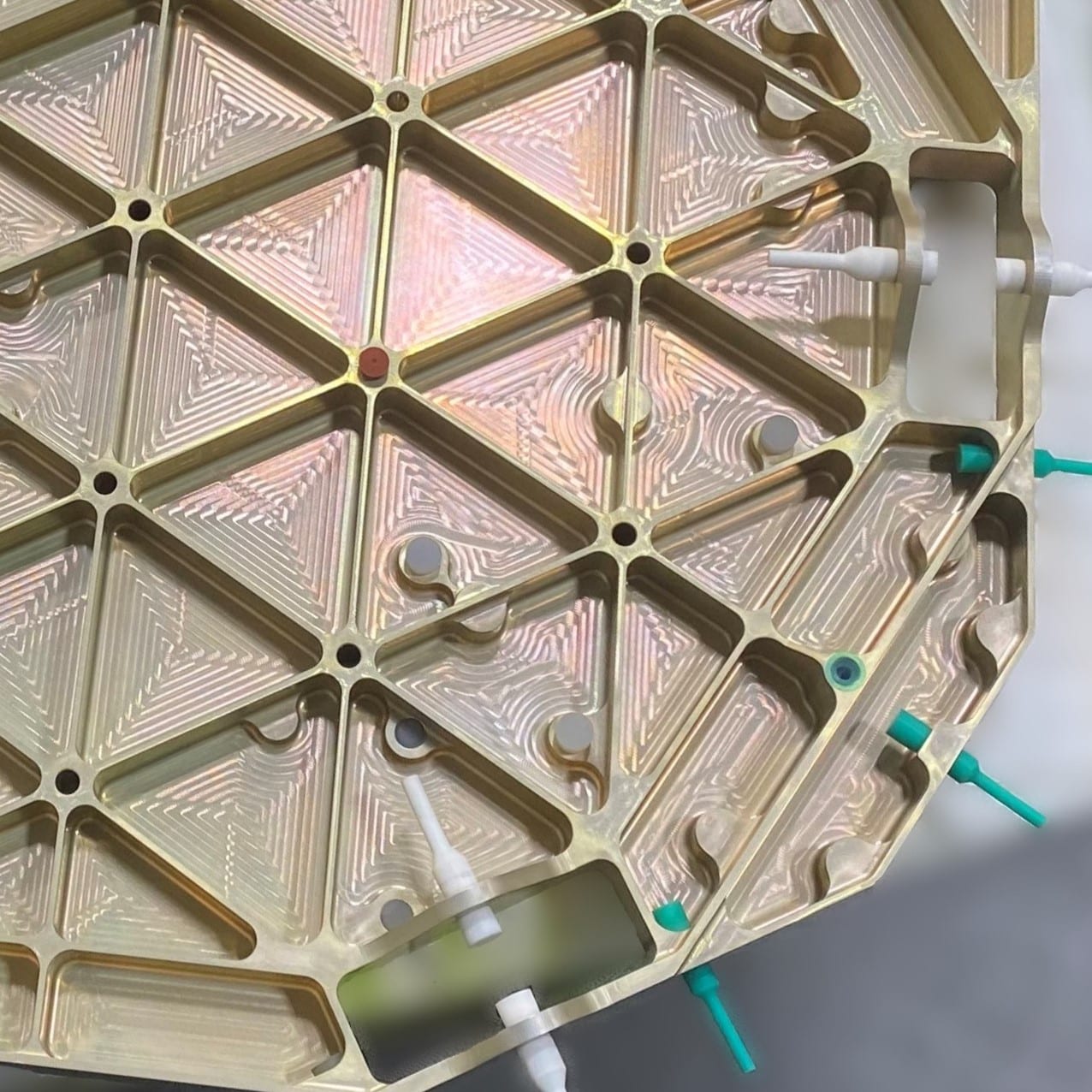
Cooling is the single greatest operational challenge in a modern data center. Servers generate intense heat, and removing that heat efficiently determines whether a facility can scale. The metal components at the heart of thermal systems — heat exchangers, cold plates, cooling distribution manifolds, piping, and fan assemblies — depend heavily on their surface properties to function as designed.
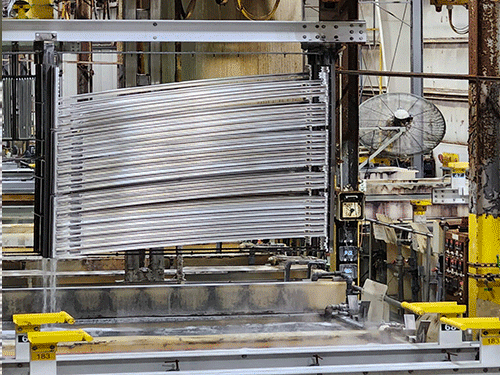
Anodizing aluminum components improves thermal emissivity and provides corrosion resistance in high-humidity cooling environments. Electroless nickel plating on heat exchangers and cooling loop piping delivers uniform coverage on complex geometries while protecting internal surfaces against the chemically aggressive fluids used in liquid cooling systems. For stainless steel piping — increasingly common in liquid cooling infrastructure — passivation is a critical post-fabrication step, removing free iron and other contaminants introduced during machining and welding to restore the clean, corrosion-resistant surface the application demands. Where dissimilar metals meet — a constant reality in cooling hardware — conversion coatings and barrier treatments prevent galvanic corrosion that would otherwise compromise heat transfer over time.
Power delivery in a data center flows through an extensive network of copper and aluminum bus bars, switchgear components, breaker contacts, and conductor terminations. The reliability of these connections is non-negotiable — even minor resistive losses generate heat, and surface degradation can lead to failures that cascade through an entire facility.
Electroless nickel and tin plating on copper and aluminum bus bars are the workhorses of this application — electroless nickel for uniform coverage and corrosion resistance, tin for reduced contact resistance and oxidation prevention at connection points. Silver plating is used on high-current contacts where conductivity requirements are most demanding. Conversion coatings on aluminum electrical components maintain surface integrity without adding resistance. These are not cosmetic treatments — they are functional engineering decisions with direct impact on system uptime.
Uninterruptible power supplies (UPS) and backup generation systems are what separate a data center from a standard commercial building. Battery enclosures, generator housings, transfer switch components, and fuel system hardware all require surface treatments that stand up to demanding environments including outdoor exposure, temperature cycling, and chemical contact.
Zinc phosphate and zinc-rich coatings provide heavy-duty corrosion protection for steel structural and enclosure components. Hard coat anodizing on aluminum generator components increases wear resistance in high-vibration environments. These treatments are applied to parts that may sit dormant for months before being called into service under emergency conditions — the finish must hold.
Data center structures are built to exacting standards — raised floor systems, server racks, cable management, structural steel, and precision-fabricated enclosures all require consistent surface treatment to meet appearance, conductivity, and durability specifications. Rack systems in particular often require finishes that provide electrical grounding continuity while resisting corrosion in controlled but demanding HVAC environments.
Suppression system components — pipe fittings, nozzle housings, valve bodies — must remain corrosion-free over the life of the facility to function reliably when needed. Metal finishing contributes to long-term system integrity in both wet pipe and clean agent suppression systems.
Building management systems, power monitoring hardware, and environmental sensor enclosures require precision-finished components that meet tight dimensional tolerances and provide EMI/RFI shielding. Electroless nickel and chromate conversion coatings are common in this application space.
Data center construction is accelerating across all segments — from hyperscale cloud campuses to edge deployments and enterprise critical facilities. Each segment has distinct finishing requirements, and Pioneer is actively working across all of them.
In the posts that follow, we’ll share specific case studies from data center projects Pioneer has completed — the systems involved, the finish specifications required, and the outcomes delivered. The goal is straightforward: to demonstrate, project by project, that Pioneer Metal Finishing is a capable and proven partner for this market.
Interested in a metal finishing partner with data center experience? Contact Pioneer Metal Finishing at www.pioneermetal.com/contact to discuss your project requirements.