Data Centers
06.04.2026



A data center is, at its root, an energy conversion engine. Electric current goes in, computation happens, and an immense volume of heat comes out.
As artificial intelligence (AI) clusters push density parameters past 100 kW per rack, thermal performance is no longer a basic building service. It has become a complex, multi-tiered engineering challenge where a microscopic failure can bring down a critical network.
For component manufacturers and contract fabricators supplying this market, the pressure is on mechanical and structural performance. But when high-performance cooling systems fail, the issue is rarely a simple electrical fault. Instead, the root cause is often a material failure:
At Pioneer Metal Finishing, we analyze data center infrastructure through the lens of surface chemistry. To build structural reliability, you must understand exactly how metal finishing impacts uptime across five distinct layers of heat rejection: Air Handling & HVAC, Mechanical Cooling, Liquid Cooling (Chip), Water and Fluid Infrastructure, and Water Treatment.

Room-level air management remains a key foundation of baseline climate control. Computer Room Air Conditioners (CRAC), Computer Room Air Handlers (CRAH), and massive building-level Air Handling Units (AHU) must continuously push millions of cubic feet of air while maintaining tight humidity and temperature envelopes.
We classify air handling as a Hyperscale Industrial (HI) opportunity:
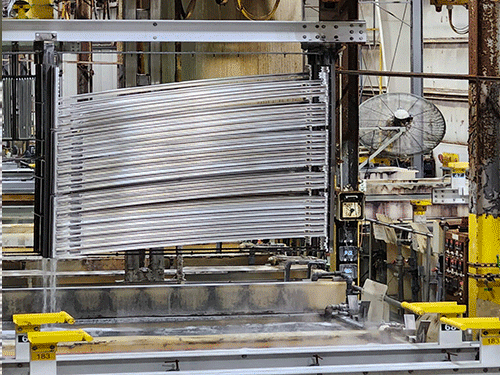
The physical challenge is long-term atmospheric consistency. Intricate Heat Exchanger (HX) coils inside CRAC and CRAH systems (often fabricated by suppliers like Modine) require specialized coatings. This protects the aluminum or copper fins from moisture-driven corrosion without adding an insulating layer that degrades heat transfer efficiency.

Traditional air-based cooling is no longer mathematically viable for high-density generative AI nodes. When a single next-generation GPU cluster demands hundreds of watts, heat must be pulled directly from the silicon via liquid loops.
Driven by an explosive Compound Annual Growth Rate (CAGR) of more than 40%, liquid cooling is a New Technology Scaling (NTS) environment with Criticality-Driven (CD) stakes:
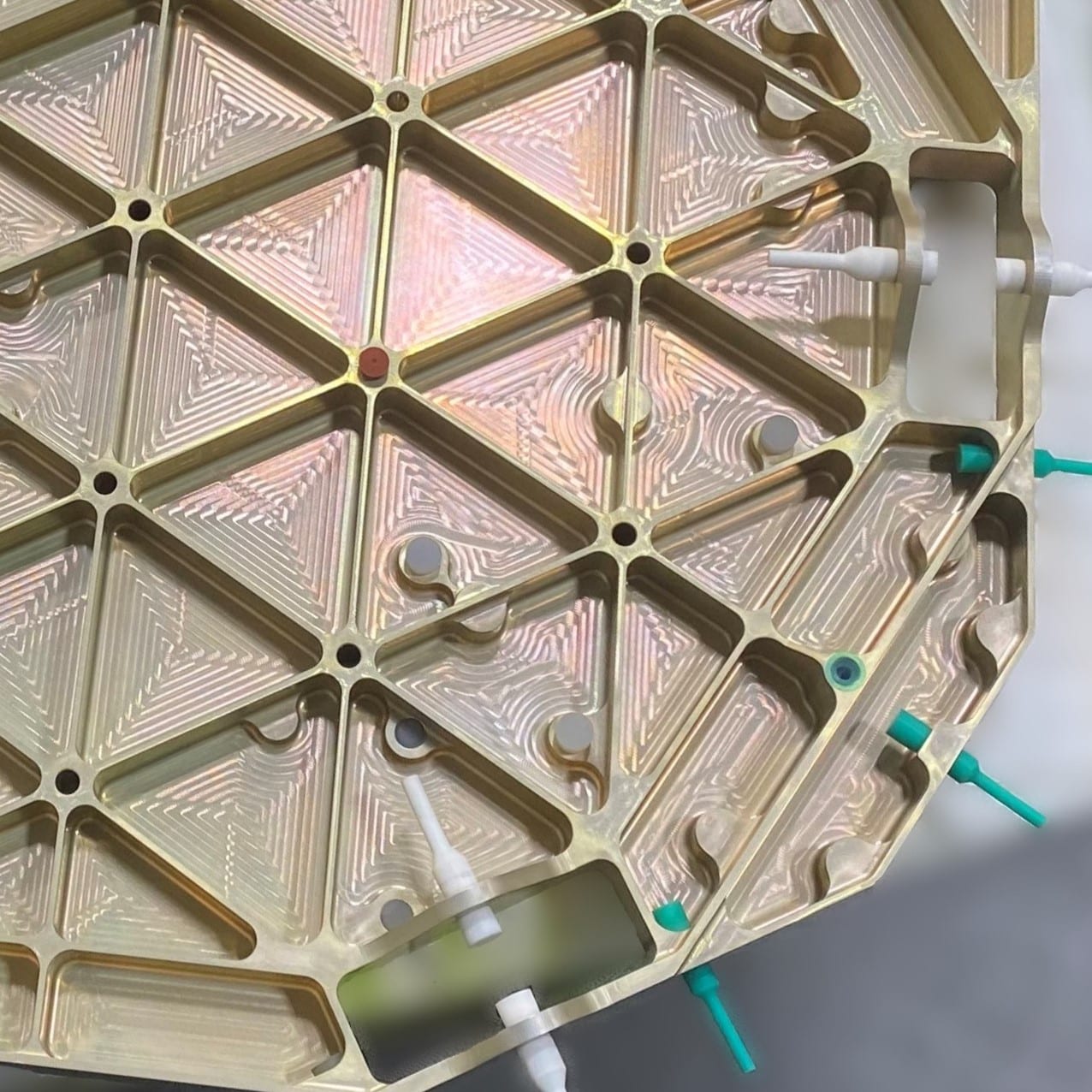
To protect these systems, aluminum cold plates require specialized Type III Hardcoat anodizing or precision Electroless Nickel (EN) plating. These processes deliver absolute surface hardness, wear resistance, and total protection against galvanic corrosion where copper meets aluminum inside the CDU and manifold lines.
Connecting the high-density chip loop to the outdoor cooling plant requires a massive network of internal process piping, transport tubing, valves, and pressurized vessels.
The primary materials in this layer are stainless steel for precision transport tubing and carbon steel for large facility pipes:
This layer frequently overlaps with other critical infrastructure. For instance, the piping containment spaces often run adjacent to Battery Energy Storage System (BESS) spaces. A single fluid leak can migrate into electrical lines, bypassing even advanced Very Early Smoke Detection Apparatus (VESDA) fire safety systems to trigger a cascade failure.
The final, essential tier of thermal management is water treatment. To maintain loop efficiency, data centers must continuously treat cooling water to prevent scale build-up and biological growth. This involves chemical dosing skids, filtration vessels, and chemical injection manifolds (built by OEMs like Evoqua or Veolia).
The metal parts inside these skids are exposed to highly concentrated, aggressive chemicals before they are diluted into the primary loop. Dosing headers and chemical injection manifolds fabricated from stainless steel or carbon steel require complete chemical resistance.
Pioneer addresses this with a combination of high-thickness electroless nickel plating and deep chemical passivation. Making these delivery systems chemically inert prevents the degradation of equipment and keeps metal ions from leaching into the cooling fluid, preserving the long-term integrity of the whole system.
Q: Why should we specify High-Phosphorus Electroless Nickel (EN) over standard electrolytic nickel for liquid cooling manifolds and microchannels?
A: Standard electrolytic nickel plating relies on an electric current, which leads to uneven deposit thicknesses, particularly in sharp corners and complex internal pathways. High-Phosphorus EN (10% to 13% P) is an autocatalytic chemical process that deposits a completely uniform layer regardless of part geometry. Furthermore, high-phos EN creates an amorphous, glass-like molecular structure without grain boundaries. This eliminates the risk of micro-scale particulate flaking and prevents metal ion leaching into ultra-pure data center dielectric or glycol fluid loops.
Q: How does Type III Hardcoat Anodizing resolve galvanic risks in mixed-metal fluid networks?
A: Liquid cooling architectures often place aluminum components in the same fluid loop as copper manifolds or heat exchangers, creating a potent galvanic cell. Specifying MIL-A-8625, Type III (Class 1) Hardcoat Anodizing converts the raw aluminum surface into an exceptionally dense, wear-resistant oxide layer (aluminum oxide). This layer acts as a complete electrical insulator, effectively breaking the electrical circuit required for galvanic coupling and protecting the underlying aluminum from rapid pitting.
Q: Why is post-weld passivation required if we are already sourcing high-grade 304L or 316L stainless steel transport piping?
A: The heat generated during orbital welding causes chromium carbide precipitation along the heat-affected zone. This pulls chromium out of the steel’s matrix, dropping the local chromium content below the 12% threshold required to maintain stainless properties. Without specifying post-weld passivation (such as ASTM A967 Nitric 2), these localized regions remain highly susceptible to rapid intergranular corrosion and stress cracking, which can lead to high-pressure leaks near electrical infrastructure.
Q: Can Pioneer scale to support hyperscale production volumes for structural components and enclosures?
A: Yes. Pioneer segments data center infrastructure into distinct technology profiles. For Hyperscale Industrial (HI) components like AHU enclosures, CRAC/CRAH cabinets, and structural assemblies, our multi-location footprint and large-format production lines are tailored for high-volume contract fabricators. We provide the regional capacity, turnaround speeds, and stringent quality audits required to match rapid data center build schedules without introducing bottleneck risks to the supply chain.
The industry discussion surrounding the data center boom often focuses on high-level capacity metrics. But reliable uptime is built at the component level.
For fabricators and OEMs serving the thermal management sector, choosing a finishing partner is not a matter of finding the lowest price per unit. It is about aligning with a partner who understands how surface engineering impacts continuous operation.
Whether it is scaling production for thousands of sheet metal HVAC enclosures or qualifying an ultra-precise EN spec for an AI cold plate, Pioneer Metal Finishing provides the engineering depth and capacity required to keep the digital world cool.
Interested in a metal finishing partner with dedicated data center experience? Contact Pioneer Metal Finishing at www.pioneermetal.com/contact to discuss your specific thermal management project requirements.