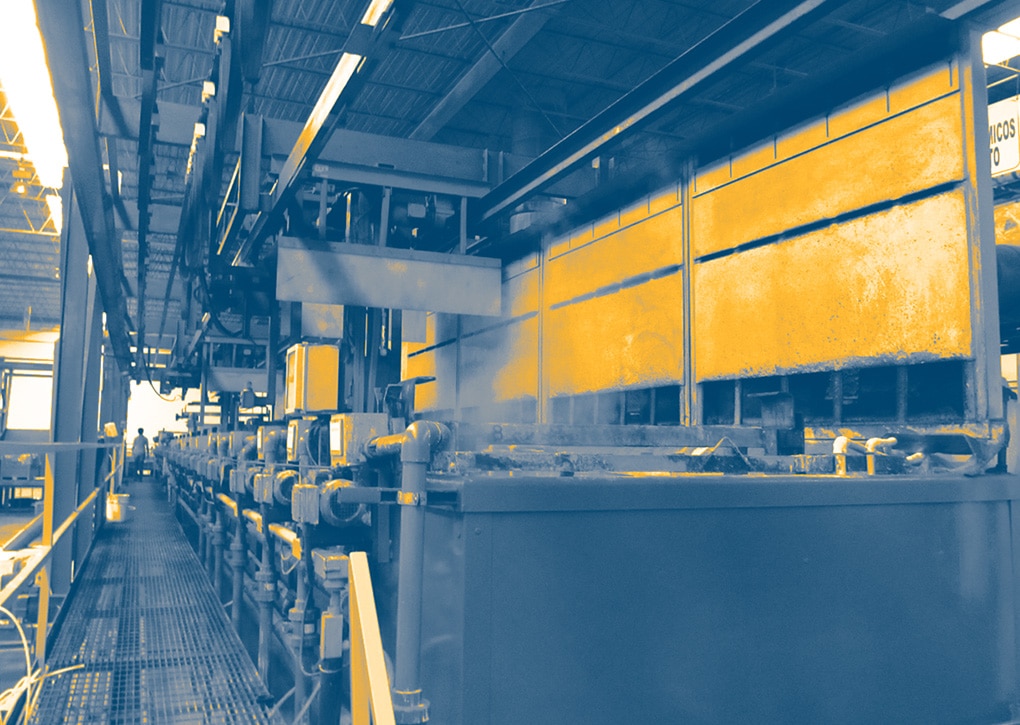
Anodizing
Q: What is anodizing?
A: Anodize is a coating of aluminum oxide that is grown from the aluminum by passing an electrical current through an acid electrolyte bath in which the aluminum is immersed. The coating thickness and surface characteristics are tightly controlled to meet end product specifications. Aluminum oxide is an extremely hard material that approaches the hardness of a diamond. As a result, the aluminum oxide layer provides excellent wear and corrosion protection.
Q: What is the purpose of anodizing?
A: General reasons for anodizing are: wear resistance, corrosion resistance, surface lubricity, heat dissipation, dielectric (non-conductive) properties, adhesion, and aesthetics.
Q: Is anodizing environmentally friendly?
A: Yes, anodize does not entail the use of heavy metals nor does it produce toxic waste. Anodizing meets the environmental and safety directives of the FDA, USDA, ELV, WEEE, and RoHS.
Q: What substrates or base metals can be anodized?
A: The three substrates that can be anodized are aluminum, titanium, and magnesium. Steel or stainless steel cannot be anodized.
Q: What is the difference between Type II “conventional anodize” and Type III “hard anodize”?
A: Type III or hard anodize offers a more dense aluminum oxide layer. To produce this requires increased electricity consumption and a super cooled electrolyte bath. Hard anodize has enhanced attributes versus Type II conventional anodize.
Q: Is there a price difference between conventional and hard anodize?
A: Hard anodize is more expensive due to increased energy requirements associated with the process. Ending cost differences are dependent upon many variables in a given order. For example: part size, racking instructions, packaging, etc.
Request Quote
Q: What alloys are best for anodizing?
A: In general, wrought alloy series 1000-7000 provide better corrosion and aesthetic properties than cast alloy. Specific alloy choices to match performance needs should be discussed on a case-by-case basis.
Q: What alloys are best for Bright Dip anodizing?
A: The following alloys are generally considered best for bright dip anodize:
- 5357
- 5457
- 5557
- 6063
- 6463
- 7016
- 7029
Q: How much substrate material is removed during the Bright Dip process?
A: Approximately 0.0002” per side for a standard 3 minute process. (Alloy Dependent)
Q: How much substrate material is removed during the etch process? (Acid & Alkaline)
A: The amount of substrate material removed during the etch process will affect part dimensions. The exact amount is alloy dependent and must be determined on a case-by-case basis.
Q: Can anodize be welded or soldered?
A: Parts can be welded prior to anodizing. The use of 5356 welding rod is strongly recommended, though some discoloration will still occur. 4043 and any 4000 series Rod is the worst choice because it will turn a smutty black when anodized. If welding is necessary after the anodize process, the coating on the portion to be welded must be removed to make electrical contact.
Q: Will anodize affect the adhesion of paint or subsequent coatings?
A: Anodize will improve the adhesion of paint and subsequent coatings.
Q: Will anodizing hide scratches?
A: Anodizing will provide minimal cover-up for surface scratches because anodize mimics the original substrate finish. To further enhance anodize appearance consider aggressive etching, hand polishing, or surface blasting.
Q: Can you partially anodize a product?
A: Aluminum parts can be masked to exclude specific portions from the anodizing process. This is commonly done using fitted plugs on threaded holes or helicoils. The masking process for anodize is more involved that it would be for paint or other coatings, however.
Q: How long does the anodize coating last?
A: Clear anodize can last indefinitely under normal conditions. In fact, anodized aluminum is often used for architecural products because it is lightweight, won’t rust, and doesn’t peel. The color dyes used in anodizing will quicklly fade in the sun however; some colors more quickly than others. TAKE CAUTION when cleaning anodized aluminum. Many cleaning chemicals, such as Windex, can break down the seal and smudge the dye.
Q: How does anodizing change the dimensions of my product? How thick is an anodize coating?
A: Anodize is not a coating in the same sense that paint or powder is a coating. Anodizing forms a layer of aluminum oxide on the surface of the part. This layer can be anywhere from 0.5 to 2 mils (0.0002 to 0.0008 inches) in thickness, depending on the process. Pilkington uses thickness meters to accurately measure the thickness of the anodize.
Electroless Nickel
Q: What are the benefits of electroless nickel plating?
A: Electroless nickel is one of the most versatile finishes, capable of meeting your needs from wear and corrosion protection to lubricity concerns. The uniform plating thickness of electroless nickel allows for tight tolerances to be achieved. “Electroless” plating avoids the snags of electroplating such as uneven buildup that can compromise threads and part tolerances, which can require post process grinding. Electroless nickel offers some of the best corrosion protection of all plated metals. At Pioneer Metal Finishing, we offer electroless nickel solutions designed specifically to produce wear resistance, corrosion protection, or lubricity.
Find Solutions
Q: What substrates can be electroless nickel plated?
A: Pioneer Metal Finishing can plate:
- All steel alloys
- All copper alloys
- All aluminum alloys
Plating Solutions
Q: What is the difference between electroless nickel and hard chrome?
A: Some applications of electroless nickel offer 1000+ hours of salt spray corrosion protection. Hard chrome can only offer 24 hours. Hard chrome offers slightly better wear protection than electroless nickel. Pioneer offers the NorLast™ electroless nickel process that provides similar wear resistance as hard chrome.
Find Out More
Q: Can an electroless nickel-plated part be stripped and replated?
A: Yes, the original electroless nickel coating can be stripped without changing the surface finish and dimensions of the substrate in many cases. Aluminum and copper alloys may become rougher and lose some base material.
Q: Can an electroless nickel-plated part be replated without stripping?
A: Yes, but the adhesion of the new plating to the old plating cannot be guaranteed.
Q: What thickness tolerance is achievable with electroless nickel?
A: Tolerances of ± 0.0001” are possible with electroless nickel plating.
Learn More
Q: What is the maximum electroless nickel coating thickness achievable?
A: Typical thickness range for production is 0.0001” to 0.005”. Theoretically it is possible to plate an unlimited amount of Electroless Nickel on a given part. Coating thicknesses beyond .005” may be more prone to chipping due to built up stresses in thicker coatings.
Learn More
Q: Why should you bake electroless nickel after plating?
A: Post-process baking minimizes hydrogen embrittlement, promotes adhesion when plating an aluminum substrate, and increases surface hardness and wear resistance.
Q: What is hydrogen embrittlement?
A: When performing the plating process, hydrogen gas is generated. When the base metal or substrate has been hardened to above 35 Rc, absorption of the hydrogen can cause parts to become brittle.
Q: Are there any negative impacts created during the baking process?
A: Depending on the bake process required, it is possible to see discoloration, reduced corrosion resistance, and reduced lubricity characteristics.
Q: What does “high phos” electroless nickel refer to?
A: Electroless nickel finishes are often distinguished by their respective phosphorous content. In particular, high phos. electroless nickel contains roughly 10-12% phosphorous, and is designed to offer supreme corrosion resistance.
Q: What is medium phos electroless nickel?
A: Pioneer Metal Finishing’s medium phos. electroless nickel is engineered to be the standard electroless nickel process providing a balanced combination of wear resistance, corrosion protection, lubricity, and affordability.
Q: How do Pioneer Metal Finishing’s specialty electroless nickel processes differ from high and medium phos. processes?
A: Other Pioneer electroless nickel finishes are engineered for more specific applications. For example, NorLast™ is designed to be the best electroless nickel application for wear resistance. NorLube™ is designed specifically to produce extreme lubricity capabilities.
Learn More
Liquid Spray Coating
Q: What paint do you use?
A: We have several paints from various suppliers that we like to use, but we can use almost any paint requested by our customers, regardless of color, texture, or formulation.
Q: Can you meet federal color standards?
A: Yes. We have several customers who require that federal standard paints be used. This requires color testing as well and is indeed part of our service capabilities.
Q: Can you apply top coat paints for aerospace?
A: Yes. We are constantly masking and painting prime and top coats for aerospace customers. Top coats often have higher visual requirements and do take more time to process, but we have been successful meeting our customers needs.
Q: Do you offer on-site liquid spray coating?
A: No. We use precision equipment and pressurized spray booths at our facility to ensure products are finished within proper processing parameters. We do not offer painting at customer locations at this time.
Stainless Steel Treatments
Q: Can you electropolish in color?
A: No. Electropolishing is the removal of material which brightens the stainless steel. This however will not add any color to your product.
Q: Do you recommend electropolishing or passivation over powder coating?
A: This largely depends on the end use of your product. Our stainless steel treatments serve many purposes by removing iron and carbon from the surface of the metal. Products are perfectly suited for the food services industry, being FDA approved. Products are used under water as they are completely corrosion resistant. Also, because electropolishing and passivation prevents rust, these processes are often used on products for the medical industry and the aerospace industry. However, powder coating is often recommended over electropolishing for other considerations including cost and versatility. Powder coated steel can be both and cheaper, and stronger on many products.
Q: Do I have to use stainless steel for electropolishing and passivation or can other alloys be processed?
A: Currently, we offer electropolishing and passivation on stainless steel only. However, electropolishing as a process can be done on other alloys, including aluminum.
Non-Destructive Testing
Q: What approvals are needed for non-destructive testing?
A: We are certified and approved by Nadcap for NonDestructive Testing. This is a requirement to be able to process aerospace products. Note that many customers will have their own approval process outside of Nadcap. It is best to check with the OEM (original equipment manufacturer) before placing an order.
Q: Do you offer other types of testing beyond dye penetrant?
A: No. Various other types of non-destructive testing exist such as mag particle or ultrasonic testing. We only offer liquid dye penetrant testing at this time.
Powder Coating
Q: What effects will the Powder Coating process have on my product?
A: Temperatures of up to 500F. Hinges, holes, helicoils, will get gummed up if not masked.
Q: What materials can be Powder Coated?
A: Aluminum, Steel, Metals. Wood and Plastic can’t typically withstand the curing temperatures. Sap or oils will come to the surface of various materials.
Q: Can you apply multiple types of Powder on the same part?
A: Definitely possible. Requires masking and multiple processes. Cost goes up.
Q: Can you Powder Coat on-site?
A: Due to curing requirements, ovens are required. Products will need to be transported to our facility.
Conversion Coating
Q: I have a product to be coated, do you recommend anodize or conversion coating as pretreatment?
A: Conversion Coating of aluminum provides a fantastic sub-surface treatment to a paint job. Iron Phosphate would be used on steel parts. Anodizing is typically used as a final finish. Both are rust inhibitors.
Q: How does Conversion Coating help with electrical conductivity?
A: Anodized aluminum is not electrical conductive and will not ground well. Conversion coating over aluminum is electrically conductive and will ground well.
Q: Why would I use RoHS compliant conversion coating?
A: Typically used in European and Asian contries, RoHS is a requirement. RoHS compliant has to do with chrome content. Chromate conversion coating is great, hexavalent chrome vs. trivalent chrome.
Heat Treating
Q: What metals or alloys can you heat treat?
A: We specialize in heat treatment of aluminum only. Metals such as steel or titanium can also be heat treated, but require temperatures that are outside our current qualified oven operating range.
Q: Do you recommend processing to a specification? What are the risks of not processing to a specification?
A: Many purchase orders will call out a processing specification. This will get you a certification for both a desired result, and a promise that the process was done within set parameters. The main disadvantage to spec or certified work is the cost. Alternatively, purchase orders may call out a result only. This can provide a major cost savings. Plus, customers get the benefit of having their work done with the same certified equipment, by the same certified operators. However, the product cannot be certified to a given specification.
Q: Can you process to specifications not listed above?
A: The specifications listed detail our current operating capabilities. Specifications such as AMS 2770 and other steel heat treatment specifications can be met, but may require a significant investment.
Component Marking
Q: What if my part isn’t flat?
A: Often times we are able to apply graphics to uneven surfaces. We would first need to see a drawing or the part itself. Screen printing is meant for flat surfaces, but our pad printing is available for more complicated parts.
Q: How large can you screen print?
A: We have screen printed as large as 15′, however, screen printing is made for longer production runs on electronic type equipment. Front panels, brackets, Chassis etc.
General Answers
Q: How can I determine which process I should choose given the operating environment?
A: Many variables are at work here. To determine the optimal process, you’ll want to contact a knowledgeable sales engineer or customer care rep for further help and clarification. Pioneer Metal Finishing offers testing solutions to identify the best process for given environments.
Connect with Us
Q: What tests are performed to verify characteristics of various processes?
A:
- Corrosion protection – Salt spray testing
- Wear resistance – Suga and Taber testing
- Hardness – Rockwell, Knoop, Vickers
- Lubricity – Coefficient of friction testing
Technologies
Q: What information is needed to generate a quote?
A:
- All contact information
- Color information (If part is to be dyed)
- Required finish
- Delivery lot size
- Yearly usage
- Blueprint or part dimensions
Get a Quote